
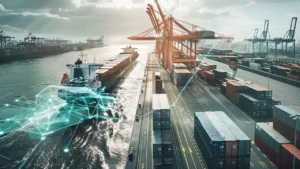
The world has now reached a volume level of nearly 900 million TEU. At each port call, mega-vessels routinely move over 12,000 containers. Traditional terminal systems cannot handle these surges. A digital twin provides a guaranteed operational benefit. Reduces terminal use by up to 20% when deployed. They also reduce the container handling time by 25%.
A digital twin in a port is a virtual replica that is dynamic. Through real-time data feeds it is always up-to-date about the yard assets, the status of the berths, and any vessels on the way in. This live visibility prevents bottlenecks before gate queues can form.
What is a Port Digital Twin?
A digital twin is a virtual, dynamic representation of the physical terminal layout, assets, and operational flows. It doesn’t just display a level view or calculate an average. Rather, it produces a 3D model with real-time interactive capability with the actual physical model of the facility.
The system makes permanent monitoring of quay cranes, yard trucks, storage blocks, and gate lanes. It connects physical resources to real-time data feeds to reflect the location of containers, equipment activities, and berthing queues.
Unlike standard simulations that evaluate isolated scenarios, a true digital twin ingests continuous data from operational sensors and database records. It provides a one-stop perspective for planners on both what is currently occurring and what will happen in the next 48-72 hours.
The Anatomy of the Live Data Stream
Continuous flow of quality field data is required to operate a digital twin. When the number of records coming in is less, the model cannot predict as well. The architecture relies on three primary layers: physical hardware, local edge processing, and database software bridges.
The Field Hardware Layer
Specialized field hardware captures physical activity in each square meter of the terminal:
- Differential GPS (dGPS) on RTG Cranes: Standard GPS often drifts by several meters. Rubber-tired gantry cranes are pinned by differential GPS to the centimeter. The system uses automatic verification to log the exact location of each container lift and deposit.
- OCR Portals at Entry Gates: Optical Character Recognition portals take photos of trucks coming in to the gates. Vehicles drive through on a low-speed pass-through, while container numbers, chassis codes, and license plates are scanned by high-speed scanners.
- Vessels on arrival: Automated telemetry and hull condition monitors. Speed change, draft depths, and propulsion status are reported directly over the marine networks with these units.
- Computer Vision and Smart Glasses: AI-equipped terminal cameras identify safety breaches and traffic jams automatically. Field inspectors wear smart glasses to stream real-time visual notes back to the terminal platform.
Connecting the Data with API Bridges
Numbers from hardware sensors must be sent to central management platforms as quickly as possible. Secure Application Programming Interfaces (APIs) connect the external vessel systems with the internal Terminal Operating System (TOS).
Real-time Automatic Identification System (AIS) transponders are connected to the digital twin. It integrates the marine AIS traffic with the ToS work queues, booking records, and gate logs. The system is not dependent on shift changeovers but updates regularly every few seconds. There is never a plan detached from ground and sea conditions.
Mitigating Gate Congestion via Predictive Sequencing
The greatest challenge to modern container yards is external truck arrival patterns. For uncoordinated yards, unassigned outside drayage trucks arrive at random intervals. If dozens of haulers show up at the same time to pick up the various boxes strewn about the same block, yard cranes soon get overwhelmed.
RTG cranes must dig through deep stacks to retrieve buried boxes. This makes the handling redundant, resulting in fuel burn, extra wear on machines, and queues at entry gates.
The digital twin can overcome this challenge by combining predictive simulations with dynamic appointment booking.
Traditional Gate Workflow:
- Trucks Arrive Randomly → Yard Congestion & Manual Digging → Crane Backlogs → Long Gate Queues
Digital Twin Predictive Workflow:
- Twin Simulates Yard Density → Optimizes Booking Slots → Smooths Truck Arrivals → Enables Direct Box Pickups
First, the system models yard density and crane job queues four hours into the future. It is aware of the vessel activities that require cranes at given berths. It also computes dwell times and search locations for stored containers.
If the model detects that Block 4 will experience heavy crane utilization between 10:00 AM and 12:00 PM, it automatically restricts truck appointment slots for that specific block. This system shuffles available open appointments to less crowded areas in the yard.
For external truckers, the website displays only calendar slots that accommodate both crane workloads. Container drop-offs and pick-ups occur predictably. Truck turnaround times are reduced, nonproductive reshuffling of containers can be reduced by up to 25%, and access roads are kept clear.
Vessel Dynamic Berth Planning and Hull Visibility
Terminal planning cannot treat landside traffic and oceanside vessel arrivals as separate problems. They form two portions of a single operational circuit. When sea events disrupt a ship schedule, terminal gates immediately feel the shockwaves.
With real-time hull visibility, it monitors inbound vessels in the open sea. Vessels are equipped with modern hull sensors and AIS connections, which monitor the position, speed over ground, engine output, and navigation conditions. This telemetry is used in the digital twin to calculate precise Estimated Times of Arrival (ETAs).
Imagine a big ocean-going ship in a heavy sea or mechanical tug. Traditional planning groups may not get around to revising plans until the ship has passed its scheduled pilot window. At this time, hundreds of export containers are awaiting their turn at the berthing, and there is serious congestion in the yard.
Firstly, a digital twin can immediately identify when the vessel slows down and predict a new ETA. It is an updated version of the master plan that notifies operators automatically.
The system enables quay crane reallocation to other vessels, berth changes, and yard stacking changes. It allocates yard spots for the incoming cargo on the revised berthing time.
Push notifications for the export trucks are provided to reschedule their gate appointment times for delayed vessels. This swift operational shift prevents expensive quay cranes from sitting idle and keeps incoming gate traffic moving smoothly.
Fallback Frameworks
In the event of an outage, broken fiber, or network issues, an automated container terminal comes to a standstill immediately. If central communication fails, gate barriers freeze, crane dispatch stops, and truck queues spill onto public roads.
To remove this vulnerability, the digital twin architectures place localized edge computing nodes within gate OCR portals, crane operator cabins, and on-site server rooms. These edge devices are used for live machine vision, gate transactions, and dGPS crane positioning that are local rather than relying on cloud servers off-site.
- Zero Gate Downtime: Even if there is no Internet connection, trucks are still being verified, and containers are scanned for code, and barriers open automatically.
- Continuous Yard Moves: RTGs move boxes continuously by accessing a local, offline slot map.
- Automatic Resynchronization: As soon as network connectivity recovers, local edge nodes push all stored transaction and movement logs back to the central digital twin platform.
This edge fallback setup guarantees complete operational continuity. Terminal operators get the predictive planning capabilities of the cloud without risking everyday physical throughput to network outages.
Editor’s Note: To protect professional privacy, this technical analysis was contributed anonymously by a senior marine engineering consultant with extensive background in alternative maritime fuel trials and zero-emission shipping compliance.